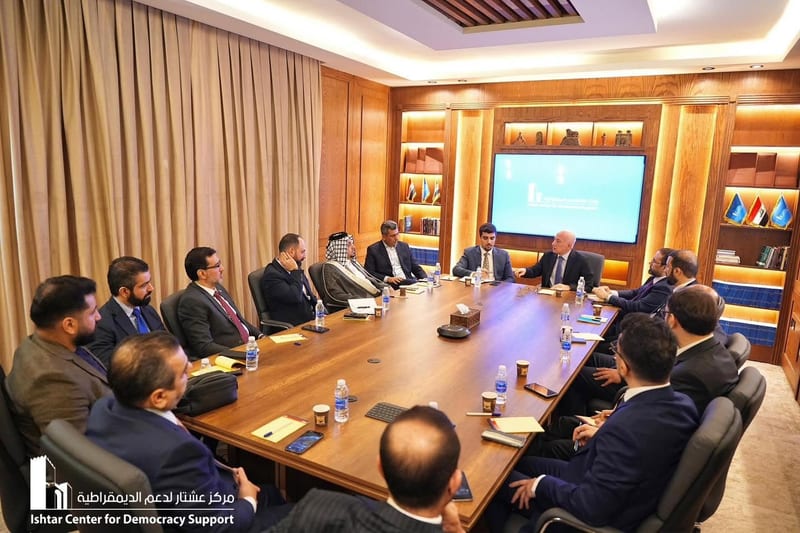
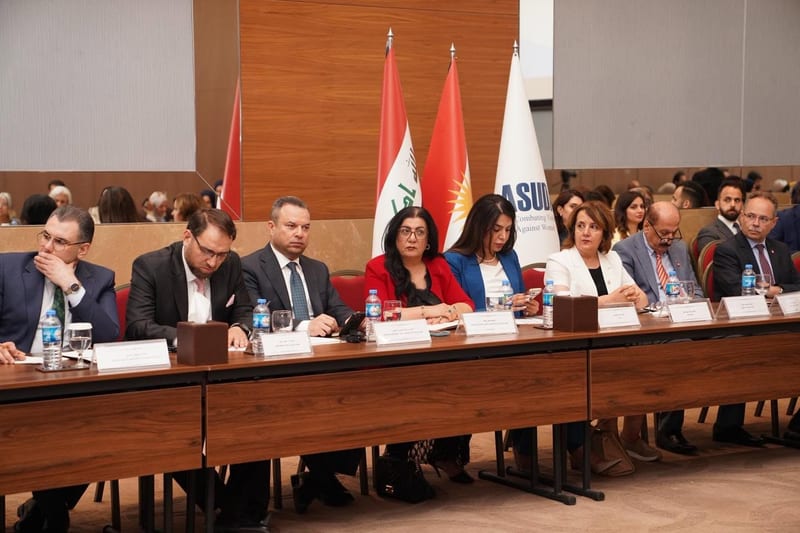
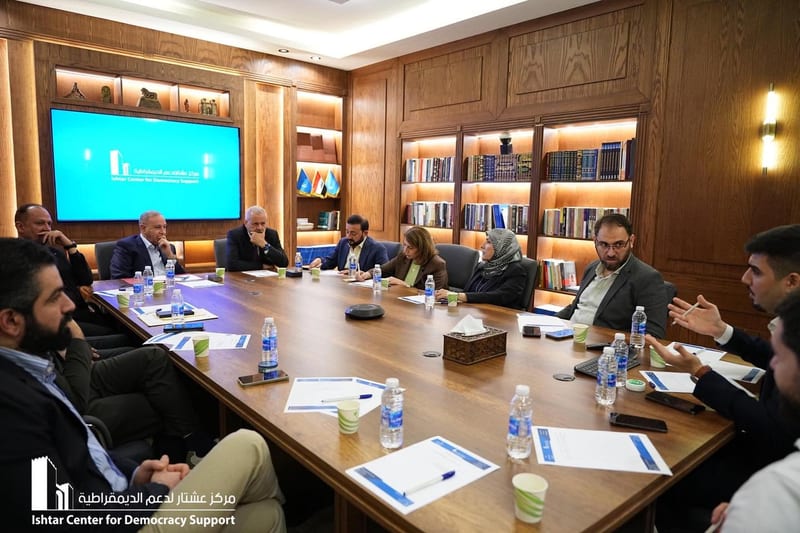
Ishtar Roundtable Discusses “U.S.-Iranian Transformations and Their Implications for Iraq” Speakers: • Dr. Nawfal Abu Al-Shon: Executive Director of ECG Group, Houston, United States; former Director of the Office of the Prime Minister. • Dr. Imad Al-Hilali: Researcher in Iranian affairs. Session Moderator: Dr. Ahmed Hameed, Director of Research Programs at Ishtar Center. Baghdad – Center Media On Saturday, 20 June 2026, Ishtar Center for Democracy Support held a closed roundtable discussion titled “U.S.-Iranian Transformations and Their Implications for Iraq.” The session examined the provisions of the recently announced understandings between Washington and Tehran and explored their deeper repercussions on the structure of the regional order and Iraq’s domestic landscape. In the first theme, dedicated to the American perspective and the diplomacy of stability and strategic containment, Dr. Nawfal Abu Al-Shon explained that the U.S. administration is presenting this agreement as a tool to promote stability through diplomacy and reduce strategic burdens, while avoiding being drawn into a broad and costly regional war. He noted that the agreement reflects a degree of political realism, as Article Eight establishes a decisive framework for keeping Iran’s nuclear program under international monitoring, thereby achieving a traditional U.S. objective. He also highlighted Article Five, which focuses on securing maritime corridors to ensure global economic stability and protect energy sources. He further pointed out that Article Six, related to reconstruction, indicates a genuine attempt to transform Iran from a rogue state into a partner within a regional economic system, thereby reducing the likelihood of future hostility. The Iranian Domestic Scene: Intellectual and Political Shifts and Cautious Openness Dr. Imad Al-Hilali shed light on the political and intellectual movements in Tehran regarding approaches to engagement with the West. He stressed that language and ideology barriers prevent Arab audiences from fully understanding the deep internal differences and the real political scene inside Iran. Al-Hilali explained that Iran is witnessing a social movement that has imposed a new reality, noting that the Iranian regime has begun to recognize the importance of social freedoms, as well as the need to improve the economic situation and the income of Iranian citizens through understandings with the United States. The session raised key questions from the attendees, along with several interventions that focused on the need for Iraq to take advantage of the current regional de-escalation in order to address its economic and security challenges through an “Iraq First” policy. In response to the interventions, Dr. Nawfal Abu Al-Shon described the agreement as a geopolitical earthquake that strikes at the narrative of rupture that has lasted for 47 years. He emphasized that Iraq stands at the center of this earthquake, facing two decisive choices. The first is a golden opportunity that could create an economic leap and transform the country into a central bridge for investments in Iran’s reconstruction, supported by a proposed USD 300 billion fund, provided that political will and sound governance are available. The second is the risk of falling into a deadly trap of strategic marginalization, especially in light of Iraq’s absence from the agreement table despite being among those most affected by previous crises, in addition to the possibility of a security vacuum and the end of the theory of “Iraq as a mediator.” The session concluded by emphasizing Iraq’s urgent need to strengthen its fragile institutions and move from the role of a passive recipient to a proactive actor capable of creating regional economic integration that protects its strategic interests in the coming phase.