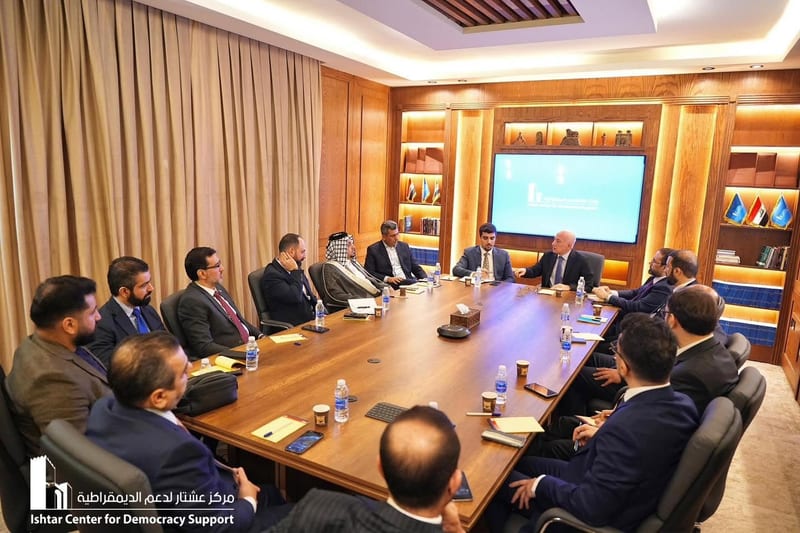
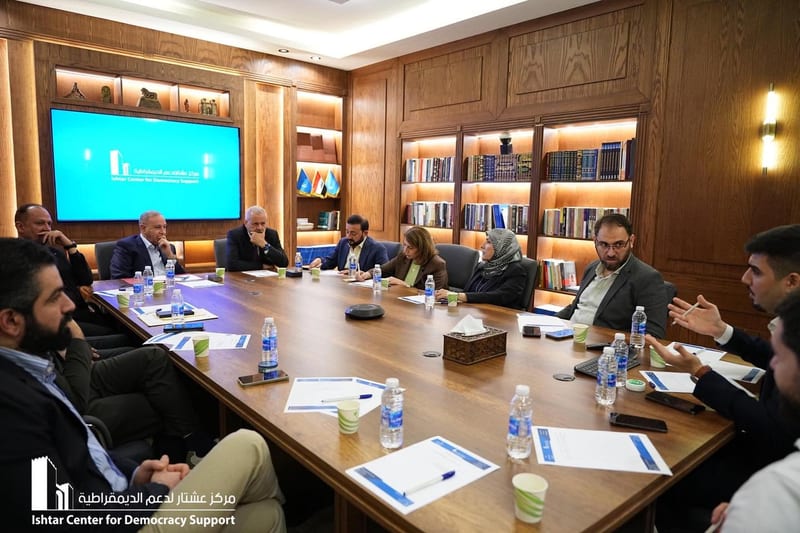
Ishtar Roundtable Discusses the Development of Studies on Social Pluralism and Democracy in Iraq Ishtar Center for Democracy Support, in cooperation with the Scientific Association for Yazidi Studies, organized an academic roundtable in Baghdad on Friday, bringing together researchers, academics, human rights activists, and specialists in the humanities. The session focused on the development of studies on social pluralism and their role in supporting democratic transformation in Iraq. The roundtable featured presentations by Dr. Yusra Khalil, President of the Scientific Association for Yazidi Studies; Dr. Saad Salloum, Professor of Political Science at Al-Mustansiriyah University; Dr. Saif Shams, Professor of Oriental Languages at the University of Brussels; and academic critic Dr. Moj Yusuf. Pluralism as a National Asset Dr. Saad Salloum opened the session by discussing the historical development of studies on religious and ethnic pluralism during the twentieth century. He emphasized that such studies are essential for understanding the structure of Iraqi society and its complex national identity. Salloum stated that Iraq’s ethnic, religious, and national diversity can be a source of strength in any society based on citizenship, dialogue, and mutual respect. He stressed that national identity must remain the inclusive umbrella for all Iraqis, away from narrow sectarian and ethnic divisions, while protecting every individual’s right to maintain their beliefs within a democratic state that guarantees equal rights for all. Dr. Yusra Khalil highlighted the efforts of the Scientific Association for Yazidi Studies to support the rehabilitation of communities in Sinjar and integrate them into a unified civil and social framework within Nineveh Governorate, away from ethnic and sectarian divisions. She noted that Iraq has suffered major tragedies that left deep scars on its social fabric, particularly during the period of ISIS terrorism. She referred especially to the catastrophe faced by the Yazidi community, whose consequences remain present today, and stressed the need to build a healthy and stable society capable of moving beyond that painful period. The “Comfortable Pillow” Dr. Saif Shams argued that conferences on peaceful coexistence will remain ineffective unless the deeper causes of exclusion are addressed. He referred to the fatwa as an executive tool that can provide a false sense of justification for excluding or rejecting the other. Shams called for investing in a new generation that rejects extremism and exclusion, and embraces the values of coexistence, recognition, and acceptance of others. The Absence of Democracy in Education Dr. Moj Yusuf focused on education as the main foundation for confronting extremism and promoting dialogue, tolerance, and openness. She pointed to what she described as the “absence of democracy in education” in Iraq, noting that censorship still affects research topics and limits academic freedom. Yusuf stressed that such restrictions weaken higher education and reduce the ability of researchers to address current challenges, especially in the humanities and social sciences, which she said often suffer from repetition and a lack of new approaches. Dr. Muhtadi Al-Abyadh, a specialist in sociology and religious anthropology, discussed the challenges faced by some religious communities in preserving their religious and cultural identity. He referred to the ongoing debate between classifying these communities within dominant religious frameworks and recognizing them as independent religious traditions with deep historical roots. The roundtable included several interventions from participants, followed by responses from the speakers. It concluded with a number of recommendations, including: 1. Strengthening dialogue between national elites and institutions to develop inclusive visions and translate them into practical action. 2. Promoting citizenship as the common reference point for all Iraqis, regardless of religious, ethnic, or national affiliation. 3. Ensuring genuine academic freedom and lifting restrictions on scientific research, especially in the humanities and social sciences. 4. Using literature and narrative to document the collective memory of Iraq’s communities and promote tolerance and recognition of others. 5. Including civic education and the values of pluralism in school curricula to protect future generations from extremism and exclusion. 6. Creating regular dialogue platforms that bring together different components of Iraqi society and encourage partnerships between civil society organizations and academic institutions. 7. Calling on the Iraqi government to adopt comprehensive development policies that restore stability, strengthen national belonging, and support democratic transformation in Iraq.